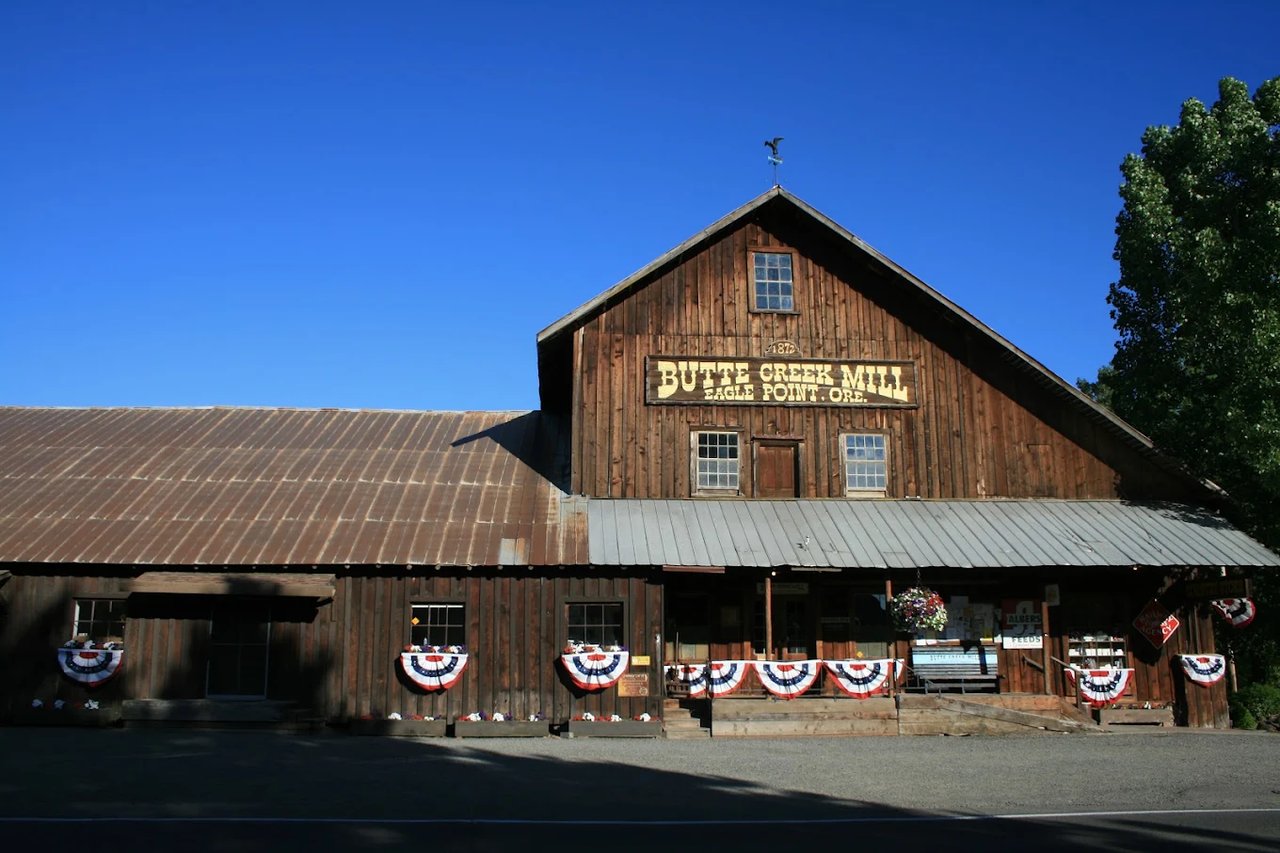
Walk along North Royal Avenue this month and you'll hear the wheel at Butte Creek Mill turning again, the way it has since 1872, water from Little Butte Creek doing the same job it did before Christmas morning 2015, when an electrical malfunction burned the landmark to the ground before dawn. Ten years later, almost to the day, the mill stands as an exact replica of the original, built board for board to match the dimensions of the nineteenth-century structure. That story made the news this past winter. What didn't make as much noise is that the mill's board didn't stop to admire the finish line. They're already planning the next phase.
That's the thing worth understanding about Eagle Point right now. The mill's decade-long rebuild reads like a closed chapter, a tidy anniversary story with a bow on it. But if you look at what's actually happening on the ground this summer, from the same stretch of Royal Avenue to a playground two blocks off Main Street, the pattern isn't completion. It's several separate projects running at the same time, on the same few blocks, mostly without anyone connecting them out loud.
A Restoration That Kept Going Past the Ribbon Cutting
The fire that took the mill burned about 70 percent of the original structure. The rebuild that followed ran for a decade and was funded by more than $2.5 million in community donations, a number that tells you this was never a project one family or one grant carried alone. It was neighbors, mostly.
This past holiday season marked what the mill's foundation called a full return to the festive tradition it lost, with a holiday market, a tree lighting, and visits from Santa back on the calendar for the first time since the fire. Board Chair Donna Fagan-Pelissier, who has led several of the mill's charitable pushes this year including a "Casa Tree" gift drive for foster children and a scholarship fund for Eagle Point High School students, put it simply:
"I felt like the community needed an opportunity to have Christmas back."
That would be a fine place to end the story. Instead, the foundation used the ten-year mark to announce what's next: a new deck with an elevator system, and a certified kitchen built for food education classes. Neither of those exists yet. Both are on the books for 2026. The mill spent ten years getting back to where it started, then immediately pointed itself somewhere it had never been.
The Creek Doing the Work Has Its Own Project Right Now
Here's the part that's easy to miss if you only know the mill as a bakery and gift shop stop. The wheel turns because of Little Butte Creek, the same creek that runs through the middle of town and that most residents cross without a second thought. This year, Eagle Point High School's Varsity Envirothon Team took on a student-led plan to improve water quality in that creek, and they're actively looking for community partners to help carry it out.
That's two separate groups working on two ends of the same waterway at the same time. One is grinding wheat with it. The other is studying what's in it. Neither project depends on the other, but both are happening because the creek running through Eagle Point isn't background scenery. It's infrastructure people are actively maintaining, in more than one direction, this year specifically.
Main Street and a Park Are Both Mid-Project Too
The mill and the creek aren't the only things under construction. The city closed the Chamberlain Park playground area starting July 31, 2026, with the city's own site promising improvements are coming, though it hasn't yet said what replaces the current equipment or when it reopens. A few blocks away on Main Street, the Planning Commission held a hearing on July 21, 2026 to consider new play courts on the quarter-acre vacant lot at 218 W Main Street, a parcel that's sat empty long enough that most people walking past it don't think of it as a future anything.
Add that up and you get four active projects inside a town of roughly 10,000 people: a historic mill entering its second phase of rebuilding, a creek being studied by high schoolers, a neighborhood playground closed for an upgrade, and a vacant downtown lot headed toward a public hearing about what gets built there. None of these are connected to each other administratively. They're connected by geography and timing. This is simply what August 2026 looks like in Eagle Point, whether or not anyone's put it in a single sentence before now.
Where That Actually Sends You This Month
If you want to see any of it in person, the itinerary is short:
- Butte Creek Mill, 402 N Royal Ave, for the working water wheel and the country store, with the understanding that the building you're standing in is about to change again before the next holiday season
- The Saturday Market, set up along the same stretch of Royal Avenue between the mill and the Museum at Eagle Point, for produce, plants, and the kind of small-batch goods that don't show up at the grocery store
- Comal Bar and Grill, 10510 OR-62, for Mexican food that's built a steady local following
- Barbwire Grill, 172 W Main St, open early for breakfast and lunch through the early afternoon
- The Antelope Bridge, a short walk from the mill, one of Oregon's 51 historic covered bridges and worth the extra five minutes if you're already downtown
None of this requires a special occasion. It's just what's within walking distance of each other on a normal Saturday this month.
The Part Worth Sitting With
A town doesn't usually rebuild its oldest landmark, study its creek, close a playground, and vote on a vacant lot all in the same summer by coincidence. It happens because enough people, from a mill foundation board to a high school science team to a planning commission, decided this was the year to do something about the piece of town in front of them. That's a different story than "historic mill reopens." It's closer to a town deciding, in several small uncoordinated ways, that this stretch of Royal and Main is worth the trouble.
If you've lived in Eagle Point long enough to remember the mill before the fire, this year is worth paying attention to. If you're newer here, this is as good a window as any into how the town actually operates, not through one big announcement but through a handful of ordinary people finishing what they started and then starting something else.
Rachel White has spent her career in the Rogue Valley watching towns like this one change block by block rather than headline by headline, and she'd rather talk with you about what's happening in your neighborhood than send you a form letter. If you're curious what a summer like this one means for a specific street or a specific house in Eagle Point, reach out to Rachel White directly, or get your instant home valuation to see where things stand today.